



Jump To
By Edita Abrudeanu, Founder & Principal Broker — Professional Insurance Experts, LLC
Your Client Requires $5 Million in Professional Liability. Should Your Design Firm Increase Its Limit?

You win the project.
Then the contract arrives.
It requires $5 million in professional liability insurance. Your firm currently carries $1 million.
Do you increase the limit, push back, or walk away?
The short answer: do not treat the requirement as a certificate-of-insurance task. Before agreeing, compare the contract language, the project exposure, your existing policy structure, the cost of the increase, and whether the added limit would apply only to this project or to every claim against the firm.
A $5 million limit may be the right decision. It may also be an expensive way to solve the wrong problem.
01. Translate the Requirement Before You Price It
“Maintain $5 million in professional liability” sounds specific. It usually is not specific enough.
Start by asking what the owner actually expects:
- $5 million for each claim, $5 million in the annual aggregate, or both?
- A firm-wide practice policy, or limits dedicated to this project?
- Coverage during design and construction only, or for a stated number of years after completion?
- Defense costs inside the limit, outside the limit, or subject to a separate defense limit?
- Evidence of current insurance, or a contractual promise that the same limits will remain continuously available?
Those are different obligations. They can produce very different pricing, underwriting, and coverage results.
Most architects and engineers buy claims-made-and-reported professional liability coverage. That makes continuous coverage, the retroactive date, reporting requirements, and the wording of any post-completion obligation important. A multi-year contract promise should not be accepted casually when the policy renews annually and future terms are subject to underwriting.
02. A $5 Million Practice Limit Is Not $5 Million Reserved for This Project
This is the point many project owners miss.
A practice policy generally covers the firm’s professional services across its covered projects. Its per-claim limit applies to one covered claim. Its aggregate is the maximum available for covered claims during the policy period, subject to the actual policy wording.
If another claim erodes the annual aggregate, the full amount shown on yesterday’s certificate may not remain available for a new claim tomorrow. Buying a $5 million practice limit therefore does not automatically dedicate $5 million to one owner or one project.
When dedicated limits are genuinely required, ask whether a project-specific policy or a project-specific additional limit endorsement is available. Those solutions are separately underwritten, may be expensive, and are not appropriate or available for every project. The party demanding dedicated protection should also be prepared to discuss the cost.
03. The Limit Is Only One Part of the Coverage Decision
A higher number at the top of the declarations page does not answer every question. Review how the policy would respond.
- Defense costs. If legal fees and expert expenses reduce the limit, a long defense can leave less money available for settlement or judgment.
- Per-claim versus aggregate structure. A $5 million aggregate paired with a lower per-claim limit may not satisfy the contract or the firm’s risk objective.
- Deductible. A higher limit quote may come with a different deductible or deductible treatment. Confirm whether the deductible applies to defense, damages, or both.
- Carrier participation and layers. A large limit may require multiple insurers or an excess structure. Compare how the layers attach and whether the terms follow the underlying policy.
- Prior acts and continuity. Do not sacrifice a favorable retroactive date or create a reporting gap merely to chase a larger limit.
- Contract language. Insurance does not make every contractual promise insurable. Warranties, guarantees, broad indemnity language, and obligations beyond the professional standard of care can create uninsured exposure even when the limit is high.
One more trap: a commercial umbrella policy generally should not be assumed to add excess limits over professional liability. Confirm the actual policies and endorsements with your broker.
04. When Increasing the Firm-Wide Limit May Make Sense
An increase can be a reasonable business decision when the larger limit supports the firm’s broader practice, not just one contract checkbox.
Consider the higher limit when:
- Multiple current or target clients require similar limits.
- The firm is moving into larger, more complex, or higher-severity project types.
- The potential impact of a design error has grown with project values, services, or responsibility for subconsultants.
- The firm’s balance sheet and risk tolerance support the deductible and uninsured exposure that remain.
- The available policy structure, carrier quality, continuity, and premium make sense after a full comparison.
A recurring $5 million requirement across the firm’s pipeline tells a different story than a single owner inserting a standard insurance exhibit into a modest project agreement.
05. When to Negotiate or Use a Project-Specific Solution
A client’s requested limit is a starting point for discussion, not proof that the number fits the exposure.
Before increasing the annual practice limit, consider whether to:
- Ask how the owner selected $5 million and whether the requirement can be tied to the project’s actual risk.
- Negotiate a lower per-claim or aggregate requirement that aligns with the firm’s existing program.
- Add a reasonable limitation-of-liability provision after consultation with qualified legal counsel.
- Require subconsultants to maintain appropriate coverage and align their contractual responsibility with the prime consultant’s obligations.
- Explore a project-specific policy, specific additional limits endorsement, or owner-procured protective solution for a large or unusual project.
- Price the incremental insurance cost into the fee when the client insists on coverage beyond the firm’s normal program.
The goal is not to avoid insurance. It is to match the insurance structure, contract, and project risk instead of buying a larger number without understanding what it accomplishes.
06. An Illustrative Comparison
Assume a 12-person engineering firm carries a $1 million per-claim/$2 million aggregate professional liability policy. It is pursuing a $6 million design fee on a complex infrastructure assignment. The owner requires $5 million per claim and $5 million aggregate for the project.
The firm has at least three paths to investigate:
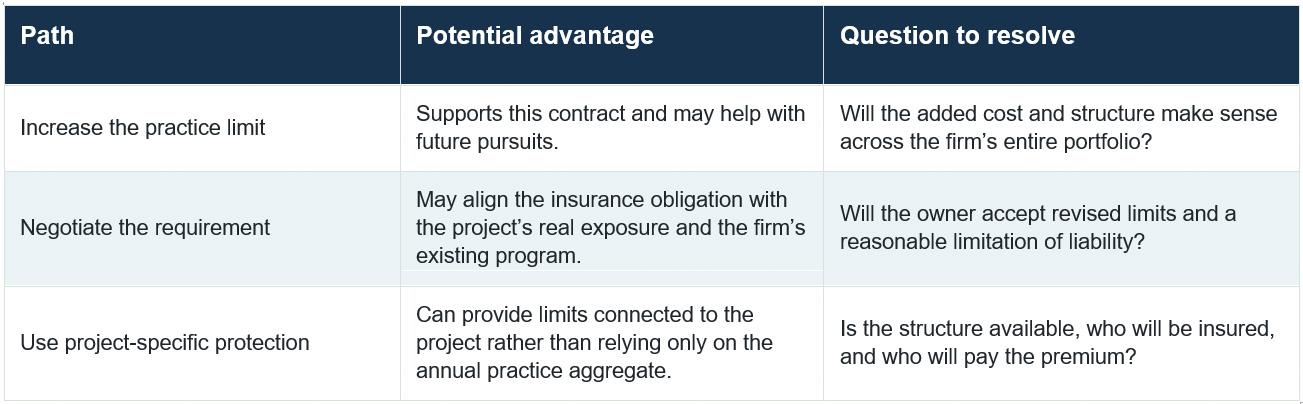
This example is illustrative, not a quote or a recommendation. Actual options depend on the firm, project, contract, application, carrier appetite, policy wording, jurisdiction, and market conditions.
07. Questions to Put in Front of Your Broker
Before signing the contract, send the insurance exhibit and the complete professional-services agreement to your broker. Ask:
- Does our current policy satisfy the requirement exactly as written?
- Are the required limits per claim, aggregate, project-specific, or some combination?
- Do defense costs reduce our limit? Is any separate defense limit available?
- What would a $5 million option cost, and would it require layers or different carriers?
- Would changing the limit affect our deductible, retroactive date, prior-acts coverage, or reporting obligations?
- Can the policy support the required post-completion period without promising future terms we cannot guarantee?
- Are project-specific limits, a specific additional limit endorsement, or owner-procured coverage available?
- Which contract obligations may remain uninsured regardless of the limit?
Get the answer before the agreement is signed. Once the contract is executed, the insurance requirement becomes your problem to solve, even if the market cannot provide the exact wording the client requested.
08. The Bottom Line
A $5 million professional liability requirement may signal a meaningful project opportunity. It may also shift a disproportionate cost or obligation onto the design firm.
Do not answer it with a reflexive yes or no.
Translate the requirement. Test it against the policy. Review the contract. Compare the available structures. Then decide whether the higher limit supports the firm’s business or merely satisfies one line in someone else’s template.
Educational notice: This article provides general insurance and risk-management information. It is not legal advice, a coverage determination, a quote, or a guarantee of available terms. Coverage depends on the policy wording, endorsements, facts, contracts, jurisdiction, carrier interpretation, and underwriting approval. Consult qualified legal counsel regarding contractual obligations.